 Seeds Exporter
Markets: importing seed from Pakistan, country by country
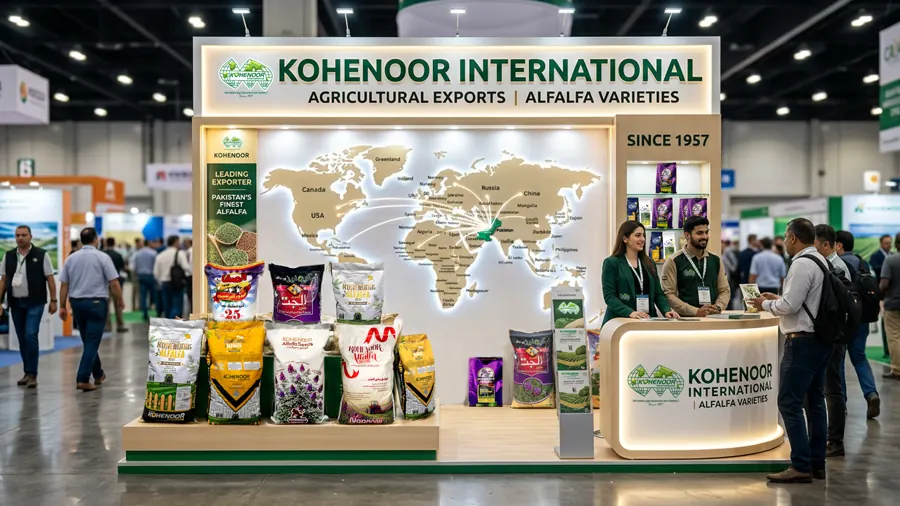
Kohenoor International exports to 70+ countries. The 56 country pages below, grouped by region, give each destination's ports, sea or road transit from Karachi, the plant-quarantine authority, the import documents it asks for and the products buyers there most often order. The Gulf and Middle East take forage seed; Africa takes sorghum, millet and rhodes; Central Asia is served by road and rail; East Asia, Europe and the Americas take sprouting seed, sesame, spices and botanicals.
How to use the country pages
Each page gives the ports we ship to, transit time from Karachi, the plant-quarantine authority, the documents that authority asks for and the products most often bought. Use it to check what to apply for before you request a quote; the import guide explains the sequence and the documents guide explains each certificate. Arabic-speaking buyers can also contract through Kehkashan International L.L.C-FZ in Dubai.
Gulf
Dairy and camel-farm buyers of alfalfa, rhodes grass and sorghum under irrigation. Sea transit 5–12 days from Karachi; phytosanitary certificate and certificate of origin are the core documents, with SABER registration for some Saudi product categories.
United Arab Emirates
Jebel Ali, Khalifa Port · 7–10 days sea from Karachi · MOCCAE
Saudi Arabia
Jeddah, Dammam · 8–12 days sea · MEWA / SFDA
Oman
Sohar, Salalah · 5–8 days sea · MAFWR
Qatar
Hamad Port · 8–11 days sea · MME
Kuwait
Shuwaikh, Shuaiba · 9–12 days sea · PAAFR
Bahrain
Khalifa Bin Salman · 9–12 days sea · MWMAUP
Middle East
Iraq, Jordan and Iran take berseem, alfalfa, Persian clover and sorghum for winter and summer forage. Iraq requires pre-shipment inspection; Iran requires an import licence and can be served by road via Taftan.
North Africa
Egypt, Libya, Tunisia, Morocco and Algeria buy alfalfa, berseem, sesbania and sorghum for dairy and reclamation projects. Import permits or authorisations are required before shipment; transit 12–22 days to Alexandria, Rades, Casablanca or Algiers.
East Africa
Sudan, Kenya, Ethiopia, Uganda and Tanzania take sorghum, pearl millet, rhodes grass, alfalfa and sesbania for livestock and reclamation. KEPHIS, MoA Ethiopia and TPHPA permits are needed; transit 10–24 days via Port Sudan, Mombasa, Djibouti or Dar es Salaam.
West Africa
Nigeria imports sorghum, alfalfa and sesbania seed through Lagos Apapa with an NAQS permit; transit 22–28 days.
Central Africa
Chad is served via Douala with onward road transport to N'Djamena, 25–35 days, mainly sorghum and sesbania.
Southern Africa
South Africa imports alfalfa, rhodes grass, sorghum and sesbania through Durban with a DALRRD permit; transit 16–20 days.
Central Asia
Uzbekistan, Kazakhstan, Tajikistan, Turkmenistan and Afghanistan are served by road and rail via Torkham, Chaman and Termez, 2–22 days, for alfalfa, sorghum, Sudan grass, ryegrass and berseem. EAEU or national quarantine permits apply.
Uzbekistan
Tashkent (rail/road via Torkham–Termez) · 12–20 days road/rail · Agroinspection
Kazakhstan
Almaty (rail) · 15–22 days road/rail · MoA Kazakhstan
Tajikistan
Dushanbe (road) · 10–15 days road · State Plant Quarantine Service
Turkmenistan
Turkmenbashi · 12–18 days · MoA Turkmenistan
Afghanistan
Torkham, Chaman (road) · 2–5 days road · MAIL
Caucasus
Armenia is reached via Poti in 20–28 days for alfalfa, sorghum and Sudan grass under an EAEU import permit.
Europe/Asia
Türkiye and Russia take alfalfa, sorghum, Sudan grass, sesbania and fenugreek; Türkiye requires a Kontrol Belgesi and Russia an EAEU permit with Rosselkhoznadzor clearance.
South Asia
Bangladesh, Sri Lanka, Nepal and India take alfalfa, sorghum, berseem, sesbania, guar and rose petals. Sea transit is short (3–12 days); import permits are required in each case.
South-East Asia
Vietnam, Thailand, Malaysia, Indonesia and the Philippines buy alfalfa, sorghum, rhodes grass, sesbania and dried chillies; each requires an import permit or SPS clearance; transit 10–20 days.
East Asia
China, Taiwan, South Korea and Japan are the main markets for sprouting alfalfa, sesame, fenugreek, sesbania, rose petals and licorice. China requires GACC registration; Korea and Taiwan have licensed-importer rules for ephedra.
Europe
EU members and the UK import sprouting seed, sesame, fenugreek, rose petals, sea buckthorn, licorice and pink salt. EU entries need a CHED-PP (seed) or CHED-D (food) in TRACES; the UK uses IPAFFS; Albania takes forage seed.
France
Le Havre, Marseille · 20–25 days sea · DGAL / EU
Germany
Hamburg · 22–26 days sea · BVL / EU
Netherlands
Rotterdam · 22–26 days sea · NVWA / EU
Italy
Genoa · 18–22 days sea · MASAF / EU
Spain
Valencia, Barcelona · 18–22 days sea · MAPA / EU
Poland
Gdańsk · 24–28 days sea · PIORiN / EU
United Kingdom
Felixstowe, Southampton · 22–26 days sea · APHA / DEFRA
Albania
Durrës · 18–22 days sea · AKU
Americas
The United States, Argentina, Brazil and Mexico buy guar, sorghum, sesame, fenugreek, rose petals and pink salt. Transit 30–45 days; USDA APHIS, SENASA, MAPA and SENASICA rules apply.
Oceania
Australia imports fenugreek, sesame, rose petals and pink salt under DAFF Biosecurity with a BICON import permit; ISPM 15 pallets are mandatory.
Not listed?
We ship to 70+ countries and the 56 pages here cover the most frequent destinations. If your country is not listed, send the quote form with your port and we will confirm requirements and transit within 24 hours. Product specifications are under products.
Frequently asked questions
Which countries buy the most seed from Pakistan?
By volume, the Gulf states (UAE, Saudi Arabia, Oman, Qatar, Kuwait) for alfalfa and rhodes grass, then Sudan, Iraq, Egypt and Afghanistan for forage seed, and China for sesame, fenugreek and guar.
Do you ship by road as well as by sea?
Yes. Afghanistan (Torkham, Chaman), Iran (Taftan) and Central Asia (via Termez) are served by truck and rail with the same document set. Everything else goes by sea from Karachi or Port Qasim.
Can you deliver from Dubai instead of Pakistan?
Kehkashan International L.L.C-FZ, our Dubai entity, can invoice and deliver to Gulf and re-export buyers who prefer a UAE counterparty. Goods still originate in Pakistan with Pakistani phytosanitary certificates.
My country is not on the list. Can you still supply?
Almost certainly. Send the destination port and product on the quote form; we confirm the phytosanitary requirements and transit within 24 hours.
Get today's FOB rate
Tell us the product, quantity and destination port. The export desk replies within 24 hours with price, MOQ, documents and transit time.
export@kohenoorint.com · +92 310 4929292 · Reply within 24 hours