 Seeds Exporter
Phytosanitary certificate and seed export documents, explained
A seed shipment from Pakistan clears customs on six standard documents, plus two or three that depend on the product and the importing country. This page explains each one: who issues it, what it certifies, how long it takes, and what buyers should check before the vessel sails. Kohenoor prepares or obtains all of them for every container.
Document summary
| Document | Issued by | Certifies | Lead time |
|---|---|---|---|
| Phytosanitary certificate | Department of Plant Protection (DPP), Government of Pakistan, Karachi | Lot inspected and found free of quarantine pests; additional declarations as required by importer | 2–4 days after inspection |
| Certificate of origin | Hyderabad Chamber of Commerce and Industry | Goods wholly produced in Pakistan; GSP Form A / preferential formats on request | 1–2 days |
| ISTA-format test report | Kohenoor in-house seed laboratory (ISTA rules) | Purity %, germination %, other seed, inert matter, moisture, dodder count, lot and date | 7–14 days (germination test duration) |
| Commercial invoice | Kohenoor International | Price, incoterm, HS code, lot, quantity, payment terms | Same day |
| Packing list | Kohenoor International | Bag count, net/gross weight per lot, container and seal numbers | Same day |
| Bill of lading | Shipping line or NVOCC at Karachi / Port Qasim | Goods received on board, consignee, notify party, freight terms | 1–3 days after sailing |
| Fumigation certificate | DPP-licensed fumigator | Container treated with phosphine or methyl bromide, dose and exposure time | 2 days, on request |
| Certificate of analysis (COA) | Kohenoor lab or accredited third-party lab (Karachi) | Moisture, oil content, microbiology, aflatoxin, heavy metals, residues as relevant | 5–10 days |
| MSDS | Kohenoor International | Safety data for herbs, spices, botanicals and salt | Same day |
| Pre-shipment inspection report | SGS / BV / Intertek / Cotecna | Quantity, quality and packing verified at loading | Booked 3–5 days ahead |
| Weight and quality certificate | Independent surveyor | Weights and sampling at loading, required by some LCs | At loading |
Phytosanitary certificate (DPP Pakistan)
The phytosanitary certificate is issued under the International Plant Protection Convention (IPPC) model by Pakistan's Department of Plant Protection, Ministry of National Food Security and Research. A DPP inspector visits our warehouse, draws a sample from the bagged lot, checks for quarantine pests and weed seed, and the Karachi office issues the certificate for that specific consignment: botanical name, quantity, number of bags, container and seal number, port of entry, consignee, and any treatment.
The part that matters most is the additional declaration. If your import permit says the seed must be 'free from Cuscuta spp.' or 'tested and found free of Clavibacter michiganensis', that sentence must appear on the certificate. We draft the declaration from your permit, confirm it with you, and pass it to DPP before inspection. A certificate with the wrong or missing declaration is the single most common reason seed is held at destination.
Validity: most NPPOs accept a certificate issued within 14 days before shipment (EU) or 30 days (many others). An e-Phyto (electronic) version is available for countries on the IPPC ePhyto hub.
Certificate of origin (Chamber)
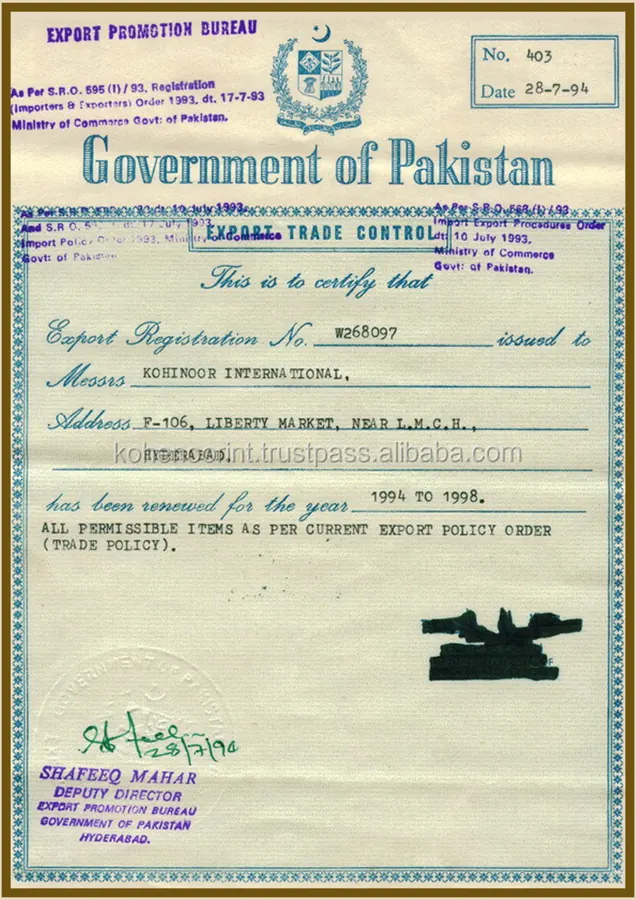
Issued by the Hyderabad Chamber of Commerce and Industry on the invoice and packing list, stamped and signed, one original and two copies. It confirms the goods are of Pakistani origin. For countries with preferential access, we can obtain GSP Form A or the bilateral format (for example the Pakistan–China FTA certificate). Arab League countries sometimes require legalisation by the embassy; allow one week extra.
ISTA-format purity and germination report
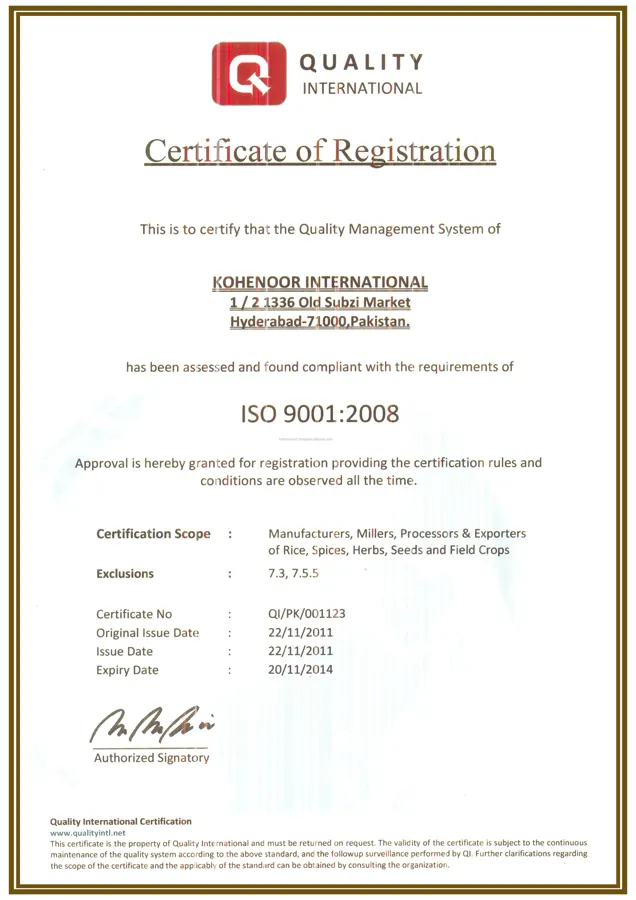
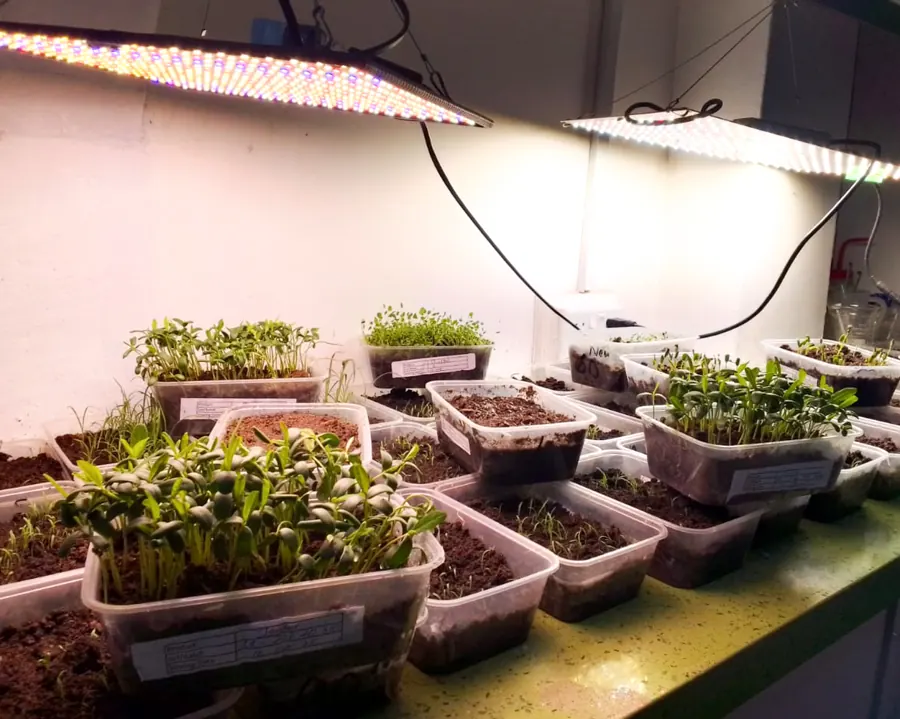
Our laboratory in Hyderabad tests to ISTA rules and reports on the ISTA layout: sample and lot number, date of sampling, purity (pure seed, other crop seed, weed seed, inert matter in % by weight on a working sample), germination (normal seedlings %, abnormal, hard, dead, on 4 x 100 seeds after the prescribed days), moisture and, for forage legumes, a dodder count on a 500 g sample. This is an in-house report issued under our ISO 9001 system, not an ISTA Orange International Certificate, which only an ISTA-accredited station can issue. If an LC or a tender requires an Orange certificate, we arrange sampling and testing at an accredited station; add three weeks and a fee.
What to check: the report date should be within 90 days of shipment; the lot number should match bag labels, packing list and phytosanitary certificate; germination method (between paper or sand, temperature) should be stated. More on the lab is on the quality page.
Invoice, packing list and bill of lading
The commercial invoice states seller, buyer, incoterm, price per kg or MT, total value, HS code, lot numbers, payment terms and, under an LC, the LC number. The packing list itemises bags per lot, net and gross weight, and container and seal numbers. The bill of lading is issued by the carrier after loading and, in an LC transaction, is the document against which the bank pays; under 30/70 terms, the 70% balance is due against its scanned copy and the original is released on payment. Check that consignee and notify party match your customs broker's instructions before the vessel sails; corrections after issue cost USD 50–150 and a day or more.
Fumigation certificate
Required by some countries (Iraq, Egypt, Iran, several African states) and by some buyers' insurers. A DPP-licensed fumigator treats the sealed container with aluminium phosphide (phosphine) or methyl bromide and certifies dose, temperature and exposure time. Phosphine does not affect germination at label doses; methyl bromide can reduce germination of some legumes if over-applied, so we use it only when the importing country insists. The certificate is issued the day after treatment.
COA, MSDS and product-specific certificates
Herbs, spices, botanicals and salt do not need a germination report; they ship with a certificate of analysis from our lab or an accredited laboratory in Karachi covering moisture, oil content, ash, microbiology (Salmonella, E. coli, total plate count), aflatoxin, heavy metals or pesticide residues as the buyer and the importing country require. An MSDS accompanies these products. Sprouting seed gets both the ISTA-format report and a microbial COA. Product pages list what is standard for each line.
- Sesame to the EU: Salmonella and ethylene oxide reports
- Pine nuts, cumin, chillies to EU/US: aflatoxin report
- Pink salt: NaCl and heavy-metal analysis
- Sprouting alfalfa, fenugreek: Salmonella and E. coli O157 absent in 25 g
- Licorice, ephedra: alkaloid or glycyrrhizin content on request
How the document flow works with your bank
Under an LC, the originals (BL, invoice, packing list, certificate of origin, phytosanitary certificate, test report, and any others the LC names) are presented to our bank within the presentation period and forwarded to yours. Under 30/70 terms, scans go to you by email as each document is issued; originals are couriered by DHL after the balance is received, or sent to your bank for release against payment if you prefer. The import guide covers the sequence, and the documents page lists what you can download or request in advance.
Frequently asked questions
Who issues the phytosanitary certificate for seed exports from Pakistan?
The Department of Plant Protection (DPP), Ministry of National Food Security and Research, Government of Pakistan, from its Karachi office, after physical inspection of the lot at the exporter's premises or the port.
Is an ISTA-format report the same as an ISTA Orange Certificate?
No. An ISTA-format report is issued by the exporter's own laboratory following ISTA rules and layout. An Orange International Certificate is issued only by an ISTA-accredited station after it samples the lot itself. Most importers accept the former; tenders and some LCs require the latter, which we arrange on request.
How long is a phytosanitary certificate valid?
It must be issued within 14 days before shipment for the EU and UK; most other countries accept 30 days. It is consignment-specific and cannot be reused.
Do you provide a certificate of origin for preferential duty?
Yes. GSP Form A and bilateral FTA formats (for example Pakistan–China, Pakistan–Malaysia, Pakistan–Sri Lanka) are obtained from the chamber on request. Tell us at contract stage so the invoice is worded to match.
Can documents be sent electronically?
Scans of every document are emailed as issued. Electronic phytosanitary certificates (ePhyto) are available for countries connected to the IPPC hub. Original bills of lading and certificates still travel by courier or through the bank.
Get today's FOB rate
Tell us the product, quantity and destination port. The export desk replies within 24 hours with price, MOQ, documents and transit time.
export@kohenoorint.com · +92 310 4929292 · Reply within 24 hours