 Seeds Exporter
Hybrid Pearl Millet (Baymisaal) exporter — Pakistan origin
Baymisaal is Kohenoor International's multi-cut hybrid pearl millet (Pennisetum glaucum) for summer fodder, exported at 98% purity and 85% germination in 25 kg bags under HS 100821. It is sold to dairy and livestock importers in Sudan, Kenya, Ethiopia, Uganda, Tanzania, Nigeria, Chad, the UAE and Saudi Arabia.
Pearl millet is free of the prussic acid risk that comes with sorghum, so it can be grazed or cut young without a waiting period. Baymisaal gives 3 cuts in 90 days with 60–70 tonnes of green fodder per hectare under irrigation and tolerates light, sandy and acidic soils where sorghum struggles.
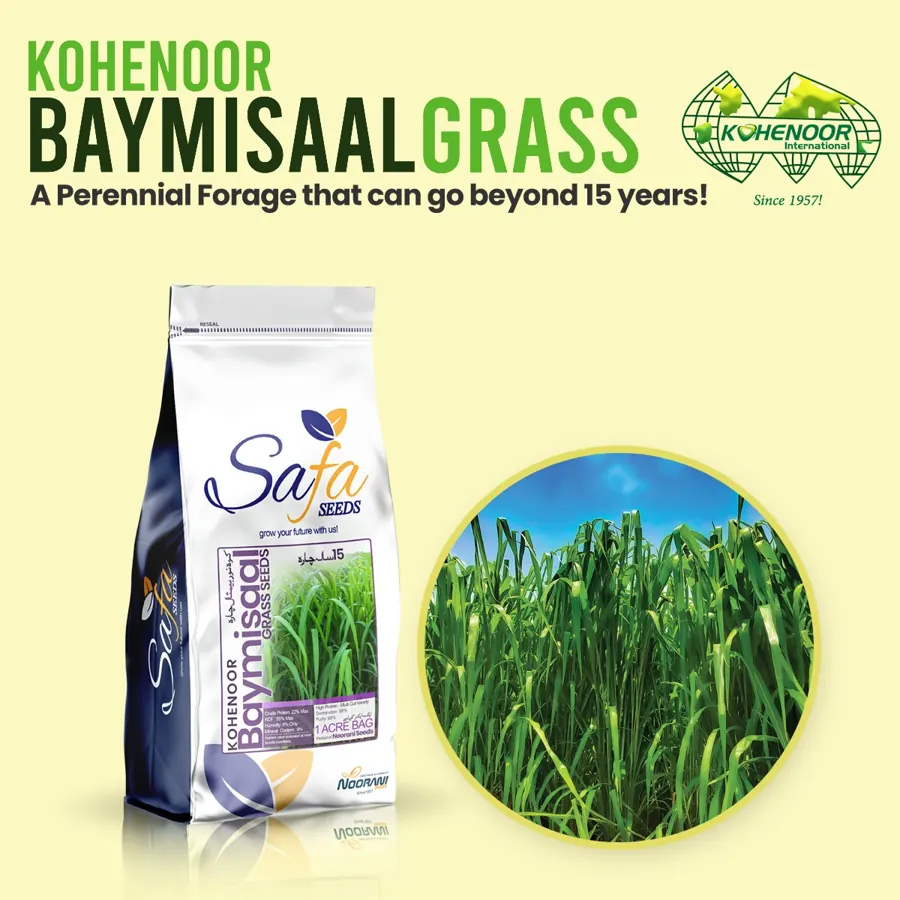
Quick answer
Specification
Standard export specification for hybrid pearl millet (baymisaal), as it appears on the pro forma invoice and the lot report. Custom specifications (higher purity, treated seed, different pack, private label) are quoted on request.
| Parameter | Specification |
|---|---|
| Botanical name | Pennisetum glaucum |
| HS code | 100821 |
| Varieties / grades | Baymisaal hybrid |
| Purity | 98% min |
| Germination | 85% min |
| Variety | Baymisaal (F1 forage hybrid) |
| Moisture | 11% max |
| Inert matter | 1% max |
| Other crop seed | 0.5% max |
| Weed seed | 0.5% max |
| Thousand-seed weight | 8–9 g (approx. 110,000–130,000 seeds/kg) |
| Colour / appearance | Grey to slate, plump, uniform |
| Hybrid purity | 98% min, grow-out checked |
| Prussic acid | None (safe for early grazing) |
| Seed treatment | Untreated; Thiram/metalaxyl on request |
| Sowing rate | 8–10 kg/ha |
| First cut | 45–50 days |
| Cuts per season | 3 in 90 days |
| Packing | 25 kg |
| MOQ | 1 x 20ft |
| Origin | Pakistan (Sindh / Punjab unless stated) |
Varieties and grades
Baymisaal hybrid. A Kohenoor-bred F1 forage pearl millet selected for leafiness, tillering and regrowth: 3 cuts in 90 days from a March–April sowing, 60–70 t/ha green weight under irrigation, 10–12% crude protein at the leafy stage and no hydrocyanic acid at any growth stage. Plants reach 1.8–2.2 m at the first cut, tiller heavily after cutting and tolerate 42 °C and light, sandy or mildly acidic soils where forage sorghum yields poorly. Dairy farms in the Gulf use it as the safest summer green chop; pastoral programmes in Sudan, Chad and Kenya sow it as emergency fodder after drought because it is grazeable at 40 days.
Because it is a hybrid, seed must be bought fresh each season; saved seed segregates and loses the multi-cut trait. We supply Baymisaal only, from our own parent lines, with a hybrid-purity grow-out on every foundation lot.
Uses by industry
Who buys hybrid pearl millet (baymisaal) from Pakistan and what they do with it.
- Dairy green chop and silage. Summer green chop and silage for dairy herds in the Gulf and East Africa; safe to feed at any stage because there is no prussic acid.
- Sheep, goat and camel grazing. Rotational grazing from 40 days in Sudan, Chad, Nigeria and the Sahel; regrows after grazing.
- Emergency and relief fodder. Drought-recovery programmes in Kenya, Ethiopia and Sudan that need fodder within six weeks of rain.
- Hay. Cut at 50–60 days and dried where sorghum cannot be cured in time; finer stems than sorghum.
- Relay and rotation. Sown after wheat in Sindh and Gezira for a 90-day fodder window before the next winter crop.
Quality control and testing
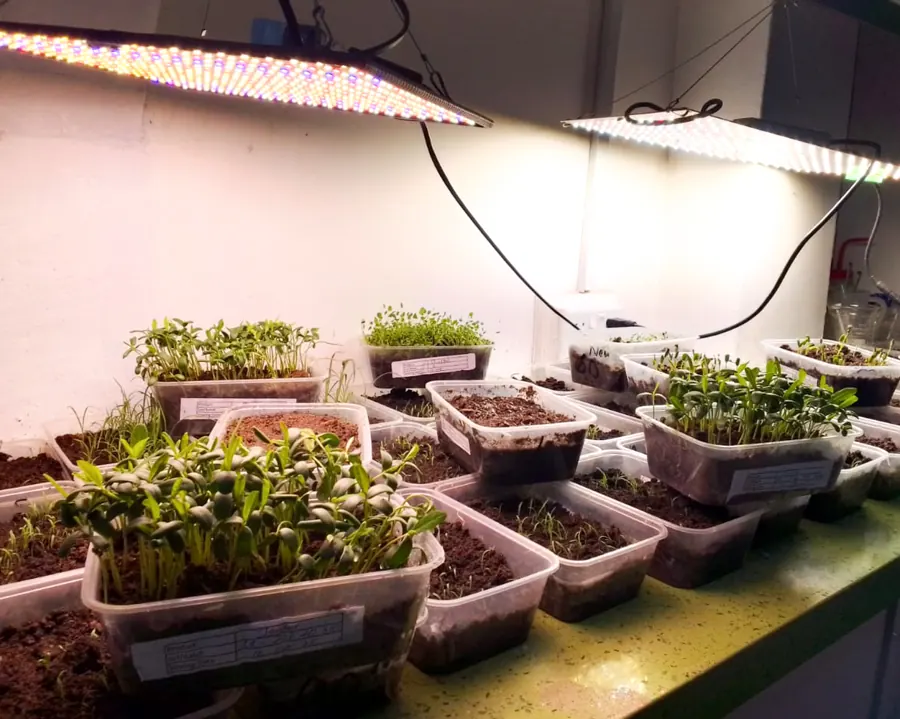
Every lot of hybrid pearl millet (baymisaal) offered for export is tested in Kohenoor's own laboratory in Hyderabad to the ISTA International Rules: a submitted sample of at least 1 kg drawn with a stick trier from a minimum of 10% of bags, purity analysis by species on a working sample (pure seed, other crop seed, weed seed and inert matter by weight), germination on 4 x 100 seeds in a controlled chamber for the prescribed period, moisture by the oven method and a thousand-seed weight. Forage legumes and small-seeded grasses also get a separate 500 g count for dodder (Cuscuta spp.) and other quarantine weed seed, which is the item most import permits ask about. Results go on an ISTA-format report with the lot number that appears on the bag labels, packing list and phytosanitary certificate.
Before the lab sees the lot it has been through air-screen cleaning, a gravity table and Buhler Sortex optical sorting, which removes off-colour, immature and weed seed that sieving cannot. A lot that misses the specification is re-sorted or dropped from export; it is never blended up. Prior-crop lots are re-tested before dispatch and no container leaves on a report older than 90 days.
For pearl millet the lab runs a hybrid-purity grow-out (400 seedlings scored for plant type) on every foundation lot, screens for ergot and smut sclerotia, and confirms the absence of Striga seed, which several African permits name. Treated seed is checked for uniformity and the treatment stated on the documents.
How to verify on arrival. Draw a composite sample from at least 10 bags with a trier, seal and label it with the lot number, and test within 14 days at your NPPO or any ISTA-accredited station. Compare against the report using the ISTA tolerance tables (about 6 percentage points between two 400-seed germination tests at the 85% level, 0.5–1.0 points for purity at 99%). If a result falls outside tolerance, send the report and the sealed bag labels within 30 days; we re-test the 1 kg reference sample we keep from every lot for 12 months and settle any confirmed difference by price adjustment or replacement.
Packing, loading and shipping
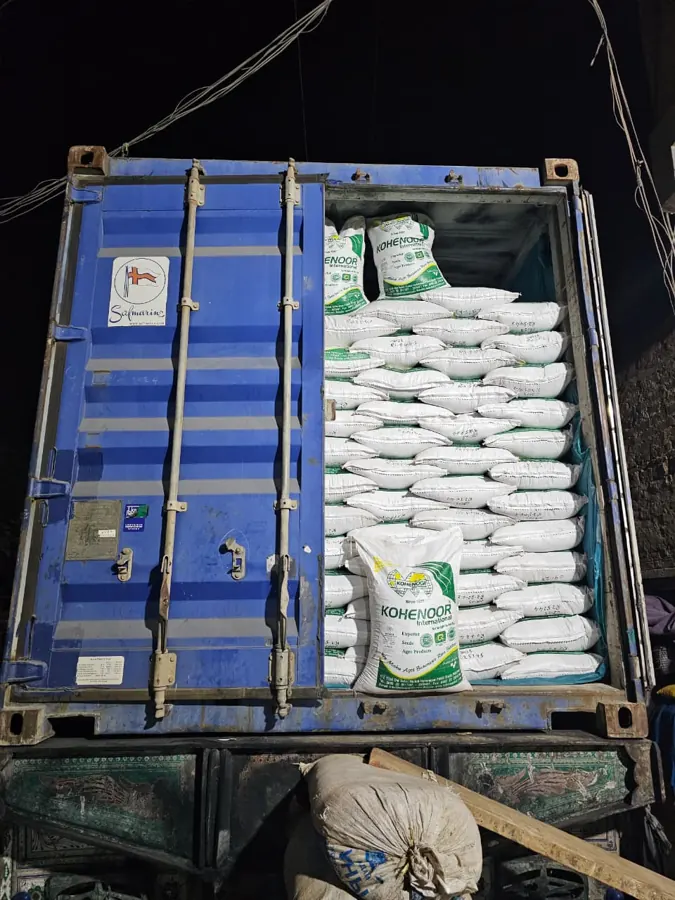
Standard packing for hybrid pearl millet (baymisaal) is 25 kg, in woven polypropylene bags with an inner polyethylene liner. Each pack is printed or labelled with product, variety or grade, lot number, net weight, origin (Pakistan), exporter and any text the importing country's labelling rules require, and closed with a sewn tear-off tag. Private-label printing is available with artwork two weeks before loading.
A 20ft container carries about 18–20 MT (about 720 x 25 kg per 20ft) loose-stacked on a kraft-paper floor in a brick pattern with a cardboard door wall; a 40ft carries about 26–27 MT. Palletised loads on ISPM 15 heat-treated pallets take roughly 10% less and are used for Europe, East Asia, North America and Australia where the container is unloaded by forklift. Desiccant bags are added for humid destinations on request. Every stuffing is photographed from empty box to applied seal and the photos go to the buyer the same day with the packing list. Full figures for every product are in the container loading guide.
Storage and shelf life. Pearl millet seed at 11% moisture in sealed lined bags keeps 85% germination for 12–15 months below 25 °C; sow hybrid seed in the season after purchase. Fumigate on arrival in humid climates and keep away from grain stores.
| Container | Net cargo | Notes |
|---|---|---|
| 20ft standard | 18–20 MT | about 720 x 25 kg per 20ft; loose on kraft-paper floor |
| 40ft / 40ft HC | 26–27 MT | Weight-limited on dense seed; volume-limited on light seed |
| Palletised (any size) | ≈ 10% less | ISPM 15 pallets, shrink-wrapped and strapped |
| LCL / air | 5 MT LCL | Higher per-kg rate; used for trial lots |
Documents and import compliance
Every container of hybrid pearl millet (baymisaal) leaves with the phytosanitary certificate from the Department of Plant Protection (DPP) Karachi carrying the importer's additional-declaration wording, a certificate of origin from the Hyderabad Chamber of Commerce, the ISTA-format purity and germination report, commercial invoice, packing list and bill of lading, plus a fumigation certificate and pre-shipment inspection report where the destination requires them. The table lists what the main destinations for this product ask for; the documents guide explains each certificate and the import guide shows the sequence.
| Country | Authority | Documents required | Transit from Karachi |
|---|---|---|---|
| Sudan | Plant Protection Directorate | Phytosanitary certificate; Certificate of origin; commercial invoice, packing list, bill of lading | 10–14 days sea |
| Kenya | KEPHIS | Phytosanitary certificate; Certificate of origin; Plant import permit; commercial invoice, packing list, bill of lading | 12–16 days sea |
| Ethiopia | MoA Ethiopia | Phytosanitary certificate; Certificate of origin; Import permit; commercial invoice, packing list, bill of lading | 10–14 days sea |
| Uganda | MAAIF | Phytosanitary certificate; Certificate of origin; Import permit; commercial invoice, packing list, bill of lading | 18–24 days |
| Tanzania | TPHPA | Phytosanitary certificate; Certificate of origin; Import permit; commercial invoice, packing list, bill of lading | 12–16 days sea |
| Nigeria | NAQS | Phytosanitary certificate; Certificate of origin; Import permit; commercial invoice, packing list, bill of lading | 22–28 days sea |
| Chad | DPVC | Phytosanitary certificate; Certificate of origin; commercial invoice, packing list, bill of lading | 25–35 days |
| United Arab Emirates | MOCCAE | Phytosanitary certificate; Certificate of origin; ISTA test report; commercial invoice, packing list, bill of lading | 7–10 days sea from Karachi |
| Saudi Arabia | MEWA / SFDA | Phytosanitary certificate; Certificate of origin; SABER registration where applicable; commercial invoice, packing list, bill of lading | 8–12 days sea |
HS classification. Pearl millet seed for sowing is HS 1008.21 (millet seed). Kenya (KEPHIS), Ethiopia, Uganda, Tanzania and Nigeria (NAQS) require a plant import permit before loading and usually a declaration of freedom from Striga and ergot; Sudan and Chad clear on the phytosanitary certificate and certificate of origin; the Gulf states likewise. Seed for sowing is duty-free in all listed markets.
Season, new crop and availability
Sown March–July, harvested September–November. New-crop seed ships from November after drying, cleaning and germination testing. African buyers sowing with the long rains (March–April) usually load in January–February; Gulf farms sowing in March order by December; Sahel buyers sowing with the June rains load in April.
Prior-crop hybrid seed is available May–October, re-tested, and stated as such. Reserve new-crop volume by August for a fixed price.
The availability calendar shows every product month by month, and prior-crop lots are always described as such on the pro forma.
Price factors and how to get today's rate
Kohenoor does not publish a price for hybrid pearl millet (baymisaal) because a price is only meaningful for a specific lot, grade, pack, quantity and date. A firm FOB Karachi or CIF quote in USD per kg or per MT comes back within 24 hours of an enquiry and is held for 7–14 days. What moves the number, in order of size:
- Crop year and timing. Pre-harvest bookings are fixed and usually lowest; spot prices rise in a short crop or when prior-crop stock runs down before new crop. Difference between the two can be 15–20%.
- Grade and purity. Hybrid seed costs more per kg than open-pollinated millet but sows at 8–10 kg/ha, so the cost per hectare is similar; treated seed and 10 kg smallholder packs add cost. Tender lots in 50 kg bags with pre-shipment inspection are priced per programme.
- Packing. 25 kg loose bags are the base; 50 kg is slightly cheaper per kg; 10 kg, cartons, private label and palletising add 2–8%.
- Quantity. Each additional container in one contract is priced 2–5% lower; LCL lots cost 20–40% more per kg because inspection, documents and handling are the same for 2 MT as for 20 MT.
- Incoterm. FOB Karachi is the base; CIF adds freight and insurance at the current line rate for your port; road delivery to Afghanistan, Iran and Central Asia is priced per truck.
- Tests and treatment. Third-party COA, residue or aflatoxin panels, SGS inspection, fumigation and seed treatment are itemised at cost.
Samples. 200 g to 1 kg from the offered lot is free against courier charges (typically USD 40–90) and goes out with the current report. Larger trial lots are invoiced at the container rate. The full logic, MOQ table and sample policy are on seed prices and MOQ.
How this compares
Pearl millet is compared with forage sorghum and with Panicum (Mombasa) as a summer fodder. Millet is the safe-to-graze, light-soil option; sorghum yields more silage on heavy soils; Panicum is the perennial that stays for years but needs a longer establishment.
| Criterion | Hybrid Pearl Millet (Baymisaal) | <a href="/products/sorghum/">Sorghum & Sudan Grass Seed</a> | <a href="/products/panicum/">Panicum (Guinea / Mombasa Grass) Seed</a> |
|---|---|---|---|
| Type | Annual F1 hybrid | Annual (F1 or OP) | Perennial |
| Prussic acid | None | Yes, wait 45–50 days | None |
| First cut / grazing | 40–50 days | 55–65 days | 70–90 days |
| Cuts | 3 in 90 days | 3–4 | 6–8 per year |
| Soils | Light, sandy, acidic OK | Heavy, fertile | Fertile, well-drained |
| Sowing rate | 8–10 kg/ha | 10–15 kg/ha | 6–8 kg/ha |
| 20ft load | 18–20 MT | 18–20 MT | 5–6 MT |
Markets served
Kohenoor has shipped hybrid pearl millet (baymisaal) to Sudan, Kenya, Ethiopia, Uganda, Tanzania, Nigeria, Chad, United Arab Emirates, Saudi Arabia. Demand comes from Gulf dairy farms wanting a safe summer green chop, and from livestock and relief programmes in Sudan, Kenya, Ethiopia, Chad and Nigeria that need fodder within six weeks of rain. Each destination has its own permit and phytosanitary wording; the country pages under markets summarise them and we prepare the certificate to match before DPP inspection.
Specialist site and further reading
Detailed agronomy, variety trials and technical downloads for hybrid pearl millet (baymisaal) are published on our specialist site kohenoorint.com. Variety-level agronomy (sowing rate, cutting schedule, seed standards, trial data) is on our reference site worldseed.net: baymisaal pearl millet. For pricing, MOQ and shipping use the quote form on this page; the lab and sorting line are described on the quality page, and all 28 lines are listed under products.

Frequently asked questions
Is Baymisaal a hybrid?
Yes, an F1 forage hybrid bred for multi-cut fodder. Fresh seed is needed every season; saved seed segregates and loses the regrowth trait. Hybrid purity is checked by grow-out on every foundation lot.
Pearl millet or sorghum for summer fodder?
Pearl millet has no prussic acid risk, tolerates lighter and more acidic soils, and can be grazed at 40 days. Sorghum yields more per cut on heavy soils and makes better silage. Many buyers take both; see the sorghum page.
Which pack sizes are available?
25 kg PP bags as standard, 720–800 bags per 20ft container. 10 kg bags for smallholder distribution programmes and 50 kg tender bags on request.
Which African ports do you ship pearl millet to?
Port Sudan, Mombasa, Djibouti, Dar es Salaam and Lagos Apapa. Transit is 10–28 days depending on port; import permits (KEPHIS, MoA Ethiopia, NAQS) are needed before loading.
What sowing rate and depth do you recommend?
8–10 kg/ha drilled at 2–3 cm in rows 30–45 cm apart into soil above 18 °C; 10–12 kg/ha broadcast. At 110,000–130,000 seeds per kg that gives about 100–120 seeds per square metre.
Can pearl millet be grazed young?
Yes. Unlike sorghum it produces no hydrocyanic acid, so it can be grazed or cut from 40–45 days and at any stage after drought or frost. Leave 15–20 cm of stubble for regrowth.
Is the seed treated?
Untreated by default. Thiram or metalaxyl treatment with a colourant is applied on request for downy-mildew-prone areas and stated on the packing list and phytosanitary certificate.
What yield does Baymisaal give?
60–70 t/ha green weight over three cuts in 90 days under irrigation in Sindh trials, at 10–12% crude protein when cut at 1.8–2.2 m; rainfed yields in the Sahel are 25–40 t/ha over two cuts.
Is Baymisaal free of Striga and ergot?
Yes. Every lot is screened in the laboratory for Striga seed and ergot sclerotia, and the phytosanitary certificate carries the additional declaration that KEPHIS, Ethiopian and Nigerian permits request.
When is new-crop pearl millet seed available?
From November after the September–November harvest. African long-rains sowings load January–February; Sahel rainy-season sowings load April; prior-crop seed is available May–October, re-tested.
Get today's FOB rate
Tell us the product, quantity and destination port. The export desk replies within 24 hours with price, MOQ, documents and transit time.
export@kohenoorint.com · +92 310 4929292 · Reply within 24 hours